


Forgiveness stories are inspiring. Reading about the Cooney family is no exception. On Thursday, March 18th, 2010 a hearing took place in which the family of a Duluth murder victim begged for the mercy. The entire courtroom including the judge was riveted by what they heard.
The story began last July when Curtis Cooney was shot in the head and killed by a man named Philbert “Randy” Barnes who was firing a gun into a crowd of people. In January “Randy” Barnes was convicted of 2nd degree murder and 2nd degree attempted murder. This past Thursday the judge handed down the sentence. Both families were present. But before the judge spoke of his sentence the Cooney family wanted to speak.
Heidi Cooney, the victim’s mother began by saying “I was raised to be forgiving, and if you want others to forgive you you need to forgive.” Curtis Cooney’s sister began to cry commenting that she lost her best friend that night. The two of them had a very special bond. Then Curtis’s father reminded everyone that “If Curtis could be here today he would forgive you, and so do we.” Cooney Sr. asked the judge to show Barnes mercy.
The Barnes family was also present in the courtroom. The older brother, tearfully apologizing to the Cooney family begged for forgiveness. Then the judge acknowledged that what he heard was extraordinary and he would take into account all that was said. After a brief recess the judge announced the sentence. Barnes was to receive 14 years in jail for attempted murder and 29 years for murder to run concurrently. Judge Johnson told those in the courtroom that it was because of “the grace of the Cooney family” he elected to sentence Barnes concurrently. The court was moved by the fact that the Cooney family forgave Barnes and that it wasn’t looking for retribution. The judge felt that it was “extraordinary” in the way the murder victim’s family and the defendant’s family came together. Steven Bynum, Barnes brother walked over to Michael Cooney and shook his hand and rubbed his cheek. Bynum then expressed his thanks to the Cooney family for the “grace, love and compassion” they extended to his family.
Once outside the courtroom Cooney Sr. said “If you’re truly consumed with hate and bitterness, that hurts you more than anything else. Carrying around hate and rage is not good for a person. Once you forgive someone, the healing process can truly begin.”
Steven Bynum responded by saying “We want Curtis Cooney’s family to have peace and that they can go forward in the joy and love of the Lord, that’s the most important thing. . .The absolute love and mercy that the Cooney family has shown to our family is just unforgettable. . . The second most important thing is that my brother have the opportunity to rebuild his life again and to take stock in what has happened. The greatest honor that he could give to the Cooney family, to Curtis and to all of us that love and support him is that he build his life anew, that he find God, and that he takes that love and joy and extends it to others. Today was an example of the power of forgiveness and redemption and reconciliation.”
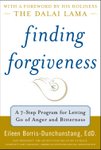
When reading this, what thoughts did you have? I would appreciate hearing them. If you have a forgiveness story you would like to share please submitted through my website www.dreileenborris.com. By sharing your stories and your struggles it will touch many other lives. You can learn more about how to forgive in “Finding Forgiveness: A 7 Step Program for Letting go of Anger and Bitterness” published by McGraw-Hill.
Showing posts with label Dr.Eileen R. Borris. Show all posts
Showing posts with label Dr.Eileen R. Borris. Show all posts
Friday, March 19, 2010


Tuesday, January 19, 2010
Why Do We Forgive?
Forgiveness takes us on a journey from the very pragmatic to the very sublime depending on our willingness to travel within the depth of our being. Our journey begins usually when our reality had been shattered and the pain of these broken pieces sears our heart. Over time the pain we carry becomes overwhelming and we think about what we can do to lessen our emotional burden. Perhaps this is the time we ask “Why Do We Forgive?” We forgive for a number of reasons. The list may include:
1. You want to stop being an angry person
2. You realize that holding on to this emotional burden is literally killing you.
3. The relationship which caused you pain is worth trying to fix.
4. You believe in the moral goodness of forgiveness.
Before we embark in learning how to forgive and begin to explore the mysteries of forgiveness I would like you to think about times in your life that you chose the path of forgiveness. Ask yourself, “Why did I forgive?” If you are struggling with a painful situation in your life now ask yourself what forgiveness can bring to you.
To start you on your journey of forgiveness I offer this simple exercise. Sit in a comfortable place where your back is straight and not rigid and your feet are on the floor. Now gently close your eyes. Take a few deep relaxing breaths and as you do I would like you to think about a situation where you would like to release pain. As you think about your situation open your heart to the universal love that surrounds you. As you breathe in imagine this energy fill your entire being. Focus on this love as it permeates every cell of your being. As you breathe out release the pain that you are holding in your heart. Feel yourself become lighter and freer with each breathe you take. Once you are filled with this universal love with each inbreathe take full responsibility for your emotional reactions to your situation and as you breathe out, breathe out the compassionate radiance of healing and forgiveness. Allow yourself to feel inner peace as you gently open your eyes.
This is a powerful exercise. It may give you the courage to face your pain and to forgive the person who may have hurt you or betrayed you in any way. It may also answer the question “Why do we Forgive?”
1. You want to stop being an angry person
2. You realize that holding on to this emotional burden is literally killing you.
3. The relationship which caused you pain is worth trying to fix.
4. You believe in the moral goodness of forgiveness.
Before we embark in learning how to forgive and begin to explore the mysteries of forgiveness I would like you to think about times in your life that you chose the path of forgiveness. Ask yourself, “Why did I forgive?” If you are struggling with a painful situation in your life now ask yourself what forgiveness can bring to you.
To start you on your journey of forgiveness I offer this simple exercise. Sit in a comfortable place where your back is straight and not rigid and your feet are on the floor. Now gently close your eyes. Take a few deep relaxing breaths and as you do I would like you to think about a situation where you would like to release pain. As you think about your situation open your heart to the universal love that surrounds you. As you breathe in imagine this energy fill your entire being. Focus on this love as it permeates every cell of your being. As you breathe out release the pain that you are holding in your heart. Feel yourself become lighter and freer with each breathe you take. Once you are filled with this universal love with each inbreathe take full responsibility for your emotional reactions to your situation and as you breathe out, breathe out the compassionate radiance of healing and forgiveness. Allow yourself to feel inner peace as you gently open your eyes.
This is a powerful exercise. It may give you the courage to face your pain and to forgive the person who may have hurt you or betrayed you in any way. It may also answer the question “Why do we Forgive?”
Sunday, January 3, 2010
The Challenge of Forgiveness
Immaculee Ilibagiza, a Rwandan woman who wrote Left to Tell (Hay House, 2006) was able to forgive the unthinkable. For 91 days of the 1994 genocide in Rwanda she hid in a tiny bathroom with seven other women in the home of her local pastor. She describes the horror she lived through and the stunning transformation she experienced because of her desire to forgive. Something happened within her where she was able to move her consciousness to deeper levels of understanding and experience inexplicable love. When the genocide ended, Immaculee met one of her family’s murderers and was able to forgive him.
How is forgiveness possible in the face of such horrific acts and what exactly is forgiveness? In the most simplistic of terms forgiveness is a willingness to let go of resentment and to stop suffering. I define forgiveness as a voluntary act in which you make a decision to see a situation differently. Instead of seeing a situation through the lens of anger, guilt or fear we see it through the eyes of compassion and understanding. I like to think of forgiveness as the science of the heart, a discipline of discovering all the ways of being that will extend your love to the world and discarding all the ways that do not. On a deeper level forgiveness is about changing the way we think which includes embracing our humanity and spiritual nature and the humanity and spiritual nature of all human beings.
In the Handbook of Forgiveness (Routledge, 2005) an anthology of scientific studies edited by Everett Worthington Jr. experts in the field expose gradations in definitions of forgiveness. In spite of this they all do agree on one thing. Unforgiveness is a state of anger, bitterness and in its extreme form hatred. Forgiveness is a prosocial change in someone’s experience after a transgression. When people choose to forgive, they change.
My question to you is, has there been something in your life in which you were able to forgive and if so, how were you changed?
How is forgiveness possible in the face of such horrific acts and what exactly is forgiveness? In the most simplistic of terms forgiveness is a willingness to let go of resentment and to stop suffering. I define forgiveness as a voluntary act in which you make a decision to see a situation differently. Instead of seeing a situation through the lens of anger, guilt or fear we see it through the eyes of compassion and understanding. I like to think of forgiveness as the science of the heart, a discipline of discovering all the ways of being that will extend your love to the world and discarding all the ways that do not. On a deeper level forgiveness is about changing the way we think which includes embracing our humanity and spiritual nature and the humanity and spiritual nature of all human beings.
In the Handbook of Forgiveness (Routledge, 2005) an anthology of scientific studies edited by Everett Worthington Jr. experts in the field expose gradations in definitions of forgiveness. In spite of this they all do agree on one thing. Unforgiveness is a state of anger, bitterness and in its extreme form hatred. Forgiveness is a prosocial change in someone’s experience after a transgression. When people choose to forgive, they change.
My question to you is, has there been something in your life in which you were able to forgive and if so, how were you changed?
Tuesday, June 30, 2009
Forgiving Bernie Madoff
Bernie Madoff, the mastermind behind one of the greatest financial frauds has been given the maximum sentence allowed for what many are saying is an extremely evil crime. People cheered and so many people are suffering because of his actions. So why am I writing about forgiveness - something which is probably the furthest thing from peoples minds. The reason - I do not want to see any more suffering. Yes, Bernard Madoff needs to pay for his crime and he is. The rest of his life will be in a jail cell. Many victims also feel that they have a jail sentence when they have to stand on line with food stamps feeling as though they will never be able to enjoy life again.
What is overlooked is that when we hold hatred and anger in our hearts that exacts a price on us. What cannot been seen by those who are victimized is that wanting an eye for an eye only means more blindness. Madoff cannot give those he stole from their money back and restore their hopes and dreams. It is now up to the victims to start a new day. It is up to them if they want to move on to more hopefulness or hold on to anger and regret. Yes, the path to forgiveness and hope is a much harder path to take even when Madoff has gotten the sentence he deserves. And yes, his sentence does not pay the bills or put food on the table. It is easier to get angry about these things but think about this. Do you want to be a victim twice over? Are you still willing to give Bernie Madoff power to hurt you while he is sitting in his jail cell? Yes, people have made a huge mistake for trusting Madoff and he is in prison now. Nothing more can be done. His freedom and luxurious life has been taken away. Madoff is being held accountable for his actions.
When we think of forgiveness we think of letting someone off the hook. This is not what forgiveness is about. Forgiveness is about healing ourselves so we can have peace of mind. It doesn't come easy yet the gift of forgiveness is not for the perpetrator but for the victim. Pragmatically forgiveness is an act of self-interest. So many times people are afraid to forgive because they do think of forgiveness as letting a person off the hook. We all need to recognize that by focusing on our anger we are inflicting more on ourselves, our bodies, our souls, our relationships - everything that is important to us. That too is a very hefty price for our hatred towards Madoff. Our anger and hatred will slowly kill us. Our self-interest comes in when the victim realizes that the best thing to do is to let go of all the pain and anger and embrace life again. Our greatest revenge is to live life well again.
What is overlooked is that when we hold hatred and anger in our hearts that exacts a price on us. What cannot been seen by those who are victimized is that wanting an eye for an eye only means more blindness. Madoff cannot give those he stole from their money back and restore their hopes and dreams. It is now up to the victims to start a new day. It is up to them if they want to move on to more hopefulness or hold on to anger and regret. Yes, the path to forgiveness and hope is a much harder path to take even when Madoff has gotten the sentence he deserves. And yes, his sentence does not pay the bills or put food on the table. It is easier to get angry about these things but think about this. Do you want to be a victim twice over? Are you still willing to give Bernie Madoff power to hurt you while he is sitting in his jail cell? Yes, people have made a huge mistake for trusting Madoff and he is in prison now. Nothing more can be done. His freedom and luxurious life has been taken away. Madoff is being held accountable for his actions.
When we think of forgiveness we think of letting someone off the hook. This is not what forgiveness is about. Forgiveness is about healing ourselves so we can have peace of mind. It doesn't come easy yet the gift of forgiveness is not for the perpetrator but for the victim. Pragmatically forgiveness is an act of self-interest. So many times people are afraid to forgive because they do think of forgiveness as letting a person off the hook. We all need to recognize that by focusing on our anger we are inflicting more on ourselves, our bodies, our souls, our relationships - everything that is important to us. That too is a very hefty price for our hatred towards Madoff. Our anger and hatred will slowly kill us. Our self-interest comes in when the victim realizes that the best thing to do is to let go of all the pain and anger and embrace life again. Our greatest revenge is to live life well again.
Forgiveness helps you recognize that what you think you see is not there
What makes forgiveness so hard to achieve is that it requires us to recognize that what we think we see in each other is not really there. What happens to all of us is that we all have our "shadows" - things about ourselves we would rather not acknowledge. We do not want to see those parts of ourselves which we have judged to be negative. Instead we use this inner lens to view the rest of the world. To heal ourselves means owning all parts of ourselves so we can make different choices and to recognize that we are all capable of doing the same things given similar circumstances. That is what forgiveness teaches us. As "A Course in Miracles" (p401, section 1) has reminded us:
"Forgiveness recognizes what you thought your brother did to you has not occurred.
It does not pardon sins and make them real. It sees there was no sin.
And in that view are all your sins forgiven.
What is sin, except a false idea about God's Son?
Forgiveness merely sees its falsity,and therefore lets it go.
What then is free to take its place is now the Will of God."
"Forgiveness recognizes what you thought your brother did to you has not occurred.
It does not pardon sins and make them real. It sees there was no sin.
And in that view are all your sins forgiven.
What is sin, except a false idea about God's Son?
Forgiveness merely sees its falsity,and therefore lets it go.
What then is free to take its place is now the Will of God."
Subscribe to:
Posts (Atom)