


During the week of April 19, 2010 I was in Rome attending meetings as a member of the Council for Dignity, Forgiveness, and Reconciliation. Created by Maria Nicoletta Gaida the Council is part of the Ara Pacis Initiative initiated by the Glocal Forum Italy Foundation and promoted by the City of Rome with the High Patronage of the Republic of Italy and under the auspices of the Prime Minister and the Italian Ministry of Foreign Affairs. The Ara Pacis Initiative is dedicated to the human dimension of peace before, during and after conflict. This project has attracted the active interest of the President of the State of Israel, Shimon Peres, and the President of the Palestinian National Authority, Mahmoud Abbas, and has been favorably received by H.M. Mohammed VI, the King of Morocco.
The project aims to launch an active reflection on forgiveness, in its various religious and cultural meanings, as a moral, spiritual and political tool for achieving reconciliation among peoples – with a particular focus on the Mediterranean and the Israeli-Palestinian conflict. This is an initiative that will bring to light and recognize the root causes of contemporary suffering and the wounds buried deep in collective memory in order to restore dignity to those who have suffered, thereby creating the premise for a reconciliation that allows for the building of a common future.
The heart of the Ara Pacis Initiative is the Council for Dignity, Forgiveness, and Reconciliation, made up primarily of men and women who have suffered personally because of armed conflict and who have chosen the path of forgiveness, and forgiveness and reconciliation experts and practitioners who work to imagine a new community, to propose the way of political forgiveness, and to develop ongoing activities aimed at raising awareness of the necessity of working on the path of forgiveness/reconciliation through education as well as intercultural and inter-religious dialogue in all fields. Through concrete projects the Council will aim to transform relations between communities in conflict to help them take the paths of reconciliation. The work of the Council will be to share their knowledge, experiences and insight concerning dignity, forgiveness and reconciliation, and initiating projects such as sending small teams of experts to promote approaches rarely used, but dramatically necessary – like forgiveness with justice, restoring dignity, and healing from trauma.
The Council will work in strict coordination with the national and international diplomatic channels and in collaboration with grassroots organizations active on the ground – on initiatives promoting reflection and participation of the various populations in the area of forgiveness. It will guide the activities related to the gathering and documenting of testimonies of conflict victims to memorialize them, as well as the selection of representatives of the victims from all sides – as victimization from hate and violence leaves no side untouched – to participate in the Council’s hearings.
Showing posts with label compassion. Show all posts
Showing posts with label compassion. Show all posts
Thursday, April 29, 2010


Friday, April 16, 2010
Council for Dignity, Forgiveness and Reconciliation
I will be working on the creation of a "Council for Dignity, Forgiveness and Reconciliation" in Rome from April 18- 26. The people on the council are a group of wise and authoritative human beings who could lead the world down the paths of understanding, forgiveness and reconciliation; a body which proposes a new form of justice, which symbolically unites the human family and is at the service of peoples in conflict, that they should not be left alone in the folly of hatred and injustice; so that dignity and forgiveness can be striven for even in the heart of darkness, so that voices of sanity and of light may be heard when calls for punishment and revenge suffocate even the remotest desire for peace, so that historical wrongs, contemporary greed, spiritual derailment and the power to humiliate can be revealed and addressed in order to create space for reconciliation. I will speak more about this when I return from Rome.
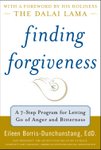
For more information on forgiveness please go to "Finding Forgiveness: A 7 Step Program for Letting Go of Anger and Bitterness" published by McGraw-Hill and to the blog on forgiveness: http://findingforgiveness.blogspot.com
www.dreileenborris.com
www.globalpeaceinitiatves.com
For more information on forgiveness please go to "Finding Forgiveness: A 7 Step Program for Letting Go of Anger and Bitterness" published by McGraw-Hill and to the blog on forgiveness: http://findingforgiveness.blogspot.com
www.dreileenborris.com
www.globalpeaceinitiatves.com
Tuesday, January 19, 2010
Why Do We Forgive?
Forgiveness takes us on a journey from the very pragmatic to the very sublime depending on our willingness to travel within the depth of our being. Our journey begins usually when our reality had been shattered and the pain of these broken pieces sears our heart. Over time the pain we carry becomes overwhelming and we think about what we can do to lessen our emotional burden. Perhaps this is the time we ask “Why Do We Forgive?” We forgive for a number of reasons. The list may include:
1. You want to stop being an angry person
2. You realize that holding on to this emotional burden is literally killing you.
3. The relationship which caused you pain is worth trying to fix.
4. You believe in the moral goodness of forgiveness.
Before we embark in learning how to forgive and begin to explore the mysteries of forgiveness I would like you to think about times in your life that you chose the path of forgiveness. Ask yourself, “Why did I forgive?” If you are struggling with a painful situation in your life now ask yourself what forgiveness can bring to you.
To start you on your journey of forgiveness I offer this simple exercise. Sit in a comfortable place where your back is straight and not rigid and your feet are on the floor. Now gently close your eyes. Take a few deep relaxing breaths and as you do I would like you to think about a situation where you would like to release pain. As you think about your situation open your heart to the universal love that surrounds you. As you breathe in imagine this energy fill your entire being. Focus on this love as it permeates every cell of your being. As you breathe out release the pain that you are holding in your heart. Feel yourself become lighter and freer with each breathe you take. Once you are filled with this universal love with each inbreathe take full responsibility for your emotional reactions to your situation and as you breathe out, breathe out the compassionate radiance of healing and forgiveness. Allow yourself to feel inner peace as you gently open your eyes.
This is a powerful exercise. It may give you the courage to face your pain and to forgive the person who may have hurt you or betrayed you in any way. It may also answer the question “Why do we Forgive?”
1. You want to stop being an angry person
2. You realize that holding on to this emotional burden is literally killing you.
3. The relationship which caused you pain is worth trying to fix.
4. You believe in the moral goodness of forgiveness.
Before we embark in learning how to forgive and begin to explore the mysteries of forgiveness I would like you to think about times in your life that you chose the path of forgiveness. Ask yourself, “Why did I forgive?” If you are struggling with a painful situation in your life now ask yourself what forgiveness can bring to you.
To start you on your journey of forgiveness I offer this simple exercise. Sit in a comfortable place where your back is straight and not rigid and your feet are on the floor. Now gently close your eyes. Take a few deep relaxing breaths and as you do I would like you to think about a situation where you would like to release pain. As you think about your situation open your heart to the universal love that surrounds you. As you breathe in imagine this energy fill your entire being. Focus on this love as it permeates every cell of your being. As you breathe out release the pain that you are holding in your heart. Feel yourself become lighter and freer with each breathe you take. Once you are filled with this universal love with each inbreathe take full responsibility for your emotional reactions to your situation and as you breathe out, breathe out the compassionate radiance of healing and forgiveness. Allow yourself to feel inner peace as you gently open your eyes.
This is a powerful exercise. It may give you the courage to face your pain and to forgive the person who may have hurt you or betrayed you in any way. It may also answer the question “Why do we Forgive?”
Sunday, January 10, 2010
Forgiveness and the Person(s) of the week - Brit Hume and Tiger Woods
We face many challenges regarding forgiveness in our lives. Turn on the news and the question of forgiveness seems to be everywhere. We are confronted with how to deal with the Bernie Madoff’s of the world and more recently issues of infidelity concerning Tiger Woods. Incidents happen on a daily basis and we all have something to say about them. So I have decided to start a column “Forgiveness and the Person of the Week,” not that we should forgive these characters, but to learn something hopefully about forgiveness and ourselves, and how to apply forgiveness in our own lives.
The buzz this week seems to be about Brit Hume and Tiger Woods. In case you missed it, Hume made the following comment on Fox News concerning Tiger Woods. Hume said "He (Tiger Woods) is said to be a Buddhist. I don’t think that faith offers the kind of forgiveness and redemption that is offered by the Christian faith. My message to Tiger would be, ‘Tiger, turn to the Christian faith and you can make a total recovery and be a great example to the world."
Suddenly there was a flurry of activity on the internet. Some people where outraged, others took sides. As I stood back and watched what was going on I had to ask myself, what is this fight really about? Granted, there are issues here and the way people reacted indicated that there were issues within us as well.
People were attacking what Brit Hume said, some either for or against Christianity. The reason we attack others is because there is something inside of us which needs to be healed. Pain is something that most of us try to avoid, yet if we are going to practice forgiveness, implicit in this is experiencing our wholeness. As in any healing work, we begin by getting in touch with what we have denied. The problem is that we are totally unaware that what bothers us so much about others is what we find most disturbing about ourselves. Since facing painful emotion about ourselves is so incredibly difficult and painful we unconsciously look for something outside of ourselves which becomes our psychological dumping grounds.
Carl Jung, a very prominent 20th century psychoanalyst called this our “shadow” or the “dark” side of personality. It functions as an inner opponent whom we struggle throughout our lives. What makes some part of our nature shadow is not its destructiveness per se; it is the fact that we are unconscious of it. The shadow has an emotional charge and presents a significant moral opposition to the ego-personality. Owning our shadow is a critical step for in not owning those aspects we begin a process of separation. We begin to see the world as good or bad, us or them. For example, when these judgments are superimposed on religious, racial, cultural or national differences, we get bigotry, racism, and the prejudices that separate and antagonize deepening the schism between us versus them. As a result, we can only see those unacceptable parts in others, and not in ourselves setting up situations of discrimination, scapegoating, victimization and even war.
Back to Brit Hume, he taught us an important lesson. Sure it is ok to have opinions but when it takes the form of an attack and we can’t seem to let go of it, then we have to ask ourselves – what are we accusing this man of? The answer we give is an indication of what needs to be healed within ourselves. The content of course will be different, but the form will be the same. In other words, we may not tell others to convert from one religion to another but we may tell people what political views they need to have. If we are willing to look at ourselves in this way and recognize that we are all capable of doing similar things then not only can we forgive ourselves, we can extend forgiveness to others for whatever we think they have done.
Only Hume knows for sure why he made his comments. Perhaps it was because of a life experience such as the death of his son in 1998 where Hume found a life preserver in faith and which he was offering it to another drowning man. We don’t really know, yet it is very interesting to watch our own behavior.
The buzz this week seems to be about Brit Hume and Tiger Woods. In case you missed it, Hume made the following comment on Fox News concerning Tiger Woods. Hume said "He (Tiger Woods) is said to be a Buddhist. I don’t think that faith offers the kind of forgiveness and redemption that is offered by the Christian faith. My message to Tiger would be, ‘Tiger, turn to the Christian faith and you can make a total recovery and be a great example to the world."
Suddenly there was a flurry of activity on the internet. Some people where outraged, others took sides. As I stood back and watched what was going on I had to ask myself, what is this fight really about? Granted, there are issues here and the way people reacted indicated that there were issues within us as well.
People were attacking what Brit Hume said, some either for or against Christianity. The reason we attack others is because there is something inside of us which needs to be healed. Pain is something that most of us try to avoid, yet if we are going to practice forgiveness, implicit in this is experiencing our wholeness. As in any healing work, we begin by getting in touch with what we have denied. The problem is that we are totally unaware that what bothers us so much about others is what we find most disturbing about ourselves. Since facing painful emotion about ourselves is so incredibly difficult and painful we unconsciously look for something outside of ourselves which becomes our psychological dumping grounds.
Carl Jung, a very prominent 20th century psychoanalyst called this our “shadow” or the “dark” side of personality. It functions as an inner opponent whom we struggle throughout our lives. What makes some part of our nature shadow is not its destructiveness per se; it is the fact that we are unconscious of it. The shadow has an emotional charge and presents a significant moral opposition to the ego-personality. Owning our shadow is a critical step for in not owning those aspects we begin a process of separation. We begin to see the world as good or bad, us or them. For example, when these judgments are superimposed on religious, racial, cultural or national differences, we get bigotry, racism, and the prejudices that separate and antagonize deepening the schism between us versus them. As a result, we can only see those unacceptable parts in others, and not in ourselves setting up situations of discrimination, scapegoating, victimization and even war.
Back to Brit Hume, he taught us an important lesson. Sure it is ok to have opinions but when it takes the form of an attack and we can’t seem to let go of it, then we have to ask ourselves – what are we accusing this man of? The answer we give is an indication of what needs to be healed within ourselves. The content of course will be different, but the form will be the same. In other words, we may not tell others to convert from one religion to another but we may tell people what political views they need to have. If we are willing to look at ourselves in this way and recognize that we are all capable of doing similar things then not only can we forgive ourselves, we can extend forgiveness to others for whatever we think they have done.
Only Hume knows for sure why he made his comments. Perhaps it was because of a life experience such as the death of his son in 1998 where Hume found a life preserver in faith and which he was offering it to another drowning man. We don’t really know, yet it is very interesting to watch our own behavior.
Subscribe to:
Posts (Atom)