


Are you still holding on to hurtful feelings about something that has happened in the past? Pain can be difficult to let go of. And yet have you ever realized that by holding on to these painful feelings you are giving away your power and control to the person who has hurt you? The truth is, when we blame another person for how we feel, we give them power and control over our emotional well-being. Since we already feel hurt by what was done to us, giving people control will only add to and prolong our suffering.
Think about it for a moment. Why would we want to give any control over to someone else who in many cases doesn’t really care about us, some of whom may even be cruel to us? After a while, if we continually blame the same person over and over again it becomes a habit and we get caught in a groove which becomes deeper and deeper. This leads us down the road of feeling helpless and hopeless and definitely like a victim. We now have become disempowered at someone else’s hands.
There is one point I would like to stress. Holding people accountable for their action is not the same as blaming them for how you feel. People can be forgiven for what they have done and also need to be held accountable for their actions. What leads to unnecessary suffering is making people responsible for your continued suffering. Remember, forgiveness allows us to regain our power, breaking the unhealthy behavior created by our anger, guilt or fear. Forgiveness requires that we do our inner work and it is this inner work which will set us free.
Exercise: Think of a time when you gave away your power to someone who may not have cared for you. It could be a cruel and abusive parent or relative, or a friend that didn’t necessarily have your best interest at heart. Or it could be a business associate who did something implying that it was “just business” totally disregarding how hard you may have worked. Or it could be a lover or spouse who has betrayed you.
Ask yourself – why am I spending so much time blaming so and so. Who is it really hurting? Why am I choosing to stay stuck in the past instead of living in the present moment and creating a more productive and peaceful future? Haven’t I suffered enough? Now look into the present and future where this situation is no longer an issue. What does your life look like now? How does it feel to be free of this burden? What have you learned about yourself? Now take a deep relaxing breathe and think about all the things to be thankful for. Hold gratitude and joy in your heart and go on with the rest of your day.
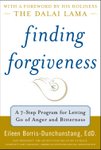
If you would like more help in learning how to forgive go to “Finding Forgiveness: A 7 Step Program for Letting go of Anger and Bitterness” published by McGraw-Hill, the website www.dreileenborris.com and the blog on forgiveness www.findingforgiveness.blogspot.com.
Showing posts with label psychology. Show all posts
Showing posts with label psychology. Show all posts
Wednesday, March 17, 2010


Wednesday, March 10, 2010
It's All My Mothers Fault and No I will NOT Forgive Her!
I remember a friend of mine telling me how mad she was at her mother. It seemed as though every time they got into a car together they would fight. There was a litany of reasons why my friend would not forgive her mother – the least of which she was stuck in the blame game.
When we blame others we are accusing them of something we believe they have done to us. We are placing fault on others insisting that they are the cause of our misery. When we are hurt because of something that has happened in the past and still feel the pain in the present we look for reasons to explain our pain. The truth is that we can never really know all the reasons why someone has hurt us, and more importantly we do not usually take the time to go within ourselves to understand what part we may have played in our life circumstances. We usually take the easy way out and like a knee jerk reaction we blame others for what may be causing our pain. That is not to say that others do not behave poorly and do things that are hurtful. What I am talking about is that when we continually blame someone else for our painful feelings, instead of making us feel better, blaming actually makes us feel worse.
Blaming causes more pain. When we blame someone else for our suffering we believe that someone else is the cause of our pain and that we need something from that person to feel better. We are dependent on them for our well being. What we actually have done is disempowered ourselves, giving other people control over how we feel. We have chosen not to take responsibility for what we are feeling.
Blaming others becomes a habit, sinking us further into the victim role. Like being in quick sand we feel powerless to change our circumstances. Underneath our need to blame is another issue that we are consistently running away from – our own feelings of guilt. Whenever we are accusing someone (blaming) of something we are secretly blaming ourselves. The content may be different but the form will be the same. If we are blaming someone for nasty horrible things they have said to us, we may not say those same kinds of things to them but if we are honest with ourselves we certainly have said unkind things to others. The important point to remember is that we are not here to beat ourselves up when we learn things about ourselves we wish we hadn’t. Now that we have gained a new understanding about ourselves we can make different choices. When we see the humanness in ourselves it is easier to see the humanness in others. Being able to then forgive ourselves we can also forgive others and stop the blame game. And remember, holding on to guilt is a choice too.
You can find more information on how to stop the blame game and to heal our guilt in “Finding Forgiveness: A 7 Step Program for Letting Go of Anger and Bitterness” published by McGraw-Hill.
When we blame others we are accusing them of something we believe they have done to us. We are placing fault on others insisting that they are the cause of our misery. When we are hurt because of something that has happened in the past and still feel the pain in the present we look for reasons to explain our pain. The truth is that we can never really know all the reasons why someone has hurt us, and more importantly we do not usually take the time to go within ourselves to understand what part we may have played in our life circumstances. We usually take the easy way out and like a knee jerk reaction we blame others for what may be causing our pain. That is not to say that others do not behave poorly and do things that are hurtful. What I am talking about is that when we continually blame someone else for our painful feelings, instead of making us feel better, blaming actually makes us feel worse.
Blaming causes more pain. When we blame someone else for our suffering we believe that someone else is the cause of our pain and that we need something from that person to feel better. We are dependent on them for our well being. What we actually have done is disempowered ourselves, giving other people control over how we feel. We have chosen not to take responsibility for what we are feeling.
Blaming others becomes a habit, sinking us further into the victim role. Like being in quick sand we feel powerless to change our circumstances. Underneath our need to blame is another issue that we are consistently running away from – our own feelings of guilt. Whenever we are accusing someone (blaming) of something we are secretly blaming ourselves. The content may be different but the form will be the same. If we are blaming someone for nasty horrible things they have said to us, we may not say those same kinds of things to them but if we are honest with ourselves we certainly have said unkind things to others. The important point to remember is that we are not here to beat ourselves up when we learn things about ourselves we wish we hadn’t. Now that we have gained a new understanding about ourselves we can make different choices. When we see the humanness in ourselves it is easier to see the humanness in others. Being able to then forgive ourselves we can also forgive others and stop the blame game. And remember, holding on to guilt is a choice too.
You can find more information on how to stop the blame game and to heal our guilt in “Finding Forgiveness: A 7 Step Program for Letting Go of Anger and Bitterness” published by McGraw-Hill.
Friday, March 5, 2010
Why Does it Have to Hurt so Much and Can Forgiveness Heal our Pain.
Feeling hurt or being wounded is unfortunately a life experience that all of us deal with. The difficulty is that we get stuck in these feelings not recognizing that we have choices which can lead to less suffering. Three elements come into play when we become wounded.
1. We take things too personally - When we take things too personally we assume that we know everything that is going on with the person who has hurt us. We judge their behavior not totally understanding what has happened in their life and the pain they may have experienced which has brought them to the place when the woundedness happened.
2 We blamed others for how we felt. - We forget that we are looking at the situation through our perceptual lenses tinted by our own emotional baggage – much of which we are unaware of. Instead of owning our shortcomings which is something we do not want to see within ourselves we can only see this behavior in others, not taking responsibility for our own behavior.
3 We get caught in the victim role - We have a tremendous investment in holding on to our pain so we can blame others, proving that I am right and you are wrong. When we choose to hold on to our pain what we are actually doing is pointing an accusing finger at the wrongdoer saying I am the innocent victim.
How do we begin to heal our wounds? The first step is an awareness process of what we are doing so that we can make other choices. If you can remember the three ingredients just mentioned you are well on your way to emotional freedom. As you tell your story, look at these three elements. By using the knowledge you are gaining about yourself you can hopefully gain insight into your own emotional reactions and begin to see the situation differently. Hopefully you will be able to handle your pain more skillfully.
Exercise: If you have written a story from the past posts you may want to revisit it and ask yourself in what way have I taken this situation too personally and how can I see it differently? Or pick a situation where you needed to forgive someone and write your story down. Then ask yourself:
• How can I see the perpetrator differently?
• What do I need to do to take responsibility for my own emotional reactions?
• What is it about myself that is hard to acknowledge which I blame others for?
Remember, we cannot change what has happened to us but we can change the way we respond to it and grow stronger as a result of the situation we find ourselves in. Life will always through us curve balls and we do not need to create more pain for ourselves as a result of the situations we find ourselves in.
For more information on learning how to forgive go to “Finding Forgiveness: A 7 Step Program for Letting go of Anger and Bitterness” by Dr. Eileen R. Borris-Dunchunstang.
1. We take things too personally - When we take things too personally we assume that we know everything that is going on with the person who has hurt us. We judge their behavior not totally understanding what has happened in their life and the pain they may have experienced which has brought them to the place when the woundedness happened.
2 We blamed others for how we felt. - We forget that we are looking at the situation through our perceptual lenses tinted by our own emotional baggage – much of which we are unaware of. Instead of owning our shortcomings which is something we do not want to see within ourselves we can only see this behavior in others, not taking responsibility for our own behavior.
3 We get caught in the victim role - We have a tremendous investment in holding on to our pain so we can blame others, proving that I am right and you are wrong. When we choose to hold on to our pain what we are actually doing is pointing an accusing finger at the wrongdoer saying I am the innocent victim.
How do we begin to heal our wounds? The first step is an awareness process of what we are doing so that we can make other choices. If you can remember the three ingredients just mentioned you are well on your way to emotional freedom. As you tell your story, look at these three elements. By using the knowledge you are gaining about yourself you can hopefully gain insight into your own emotional reactions and begin to see the situation differently. Hopefully you will be able to handle your pain more skillfully.
Exercise: If you have written a story from the past posts you may want to revisit it and ask yourself in what way have I taken this situation too personally and how can I see it differently? Or pick a situation where you needed to forgive someone and write your story down. Then ask yourself:
• How can I see the perpetrator differently?
• What do I need to do to take responsibility for my own emotional reactions?
• What is it about myself that is hard to acknowledge which I blame others for?
Remember, we cannot change what has happened to us but we can change the way we respond to it and grow stronger as a result of the situation we find ourselves in. Life will always through us curve balls and we do not need to create more pain for ourselves as a result of the situations we find ourselves in.
For more information on learning how to forgive go to “Finding Forgiveness: A 7 Step Program for Letting go of Anger and Bitterness” by Dr. Eileen R. Borris-Dunchunstang.
Thursday, January 14, 2010
What Does Freud Have to do with it - The Forgiveness Process that Is!
The profound healing effect of forgiveness lies in its capacity to change the way we think. To help us understand how this happens I would like to give you a brief lesson in how our thinking developed and how it relates to what we call our unconscious mind.
At the turn of the 19th century a very prominent psychoanalyst by the name of Sigmund Freud laid the groundwork for understanding the psychoanalytical view on the way we think. He was especially brilliant when he introduced the concept of psychological defense mechanisms to keep unacceptable impulses, desires, and thoughts out of conscious awareness. Freud believed that one never strives so hard against something unless one was correspondingly attracted to it, even if that attraction remained out of awareness.
Although during Freud’s time psychology and spirituality were kept quite separate from one another that relationship began to change dramatically during the 1960’s. A “Third Force” known as Humanistic psychology came into existence, (with psychoanalysis and behaviorism being the first and second). From it emerged theorist such as Abraham Maslow, Carl Jung, and Carl Rogers. Their focus shifted from the psychoanalytical view that reduces human behavior and experience to unconscious sexual forces, to a view which respected our creative and spiritual strivings, placing a greater emphasis on the present and future rather than being chained to the past.
As Humanistic psychology further developed, a “fourth force” began to grow known to the field as transpersonal psychology. Transpersonal psychology began to explore the ‘S’elf, which they defined as our source of creativity and spirituality and beyond our personal self. This led humanistic and transpersonal psychology to look increasingly to spirituality as a guiding force for their investigations bringing them closer to the Eastern spiritual traditions, predominantly Hinduism or Buddhism.
With the advent of humanistic and transpersonal psychology we began to understand the struggles we were having in accepting our spirituality. As theories emerged they expanded that of Freud’s, opening up the possibility that within us is a divine spark or “Higher Self.” As these newer theories matured, Freud’s ‘ego’ took on a different meaning. Carl Jung who was a student of Freud defined the ‘ego’ as meaning ‘false self’ or the persona we put out for the world to see. This persona included our shadow, those parts of ourselves which we keep hidden. Jungian psychology then went beyond Freudian theory acknowledging that there is also a part within us that transcends our ‘ego’ and which makes up our higher nature. Unfortunately we have focused so much on creating who we think we should be, getting so wrapped up in our ego that we have come to deny our divinity.
According to Jung, when we denied our spiritual nature we imposed an image on ourselves based on a false belief that it was possible to be separate from our spiritual source. In accepting this belief as fact, we created a conflict within our psyche. The psychological pain of this conflict is so deeply imbedded within us that we experience this state of separation as anxiety. Karen Horney, a prominent psychoanalyst, describes this anxiety in terms of feeling isolated and helpless in a world conceived as potentially hostile.
The psychological term used to describe basic anxiety is neurosis. Carl Jung considered neurosis a warning issued by a higher authority, reminding us that our personality is in need of broadening to ultimately include the central “power,” that part which embraces all of who we are. Sigmund Freud was so afraid of this power that he constructed a thought system virtually invulnerable to the threat of spirit and a defense against our true “Self.”
How did this all happen? Why did we choose to focus on our “false” self as the ego is often called, to the detriment of the divinity within?
And how is this relevant to the understanding of the forgiveness process? Interestingly there is a myth common to Western civilization, the creation story, which explains all of this. Although we think of this story as a description of our physical creation, for some it is also a story of the birth of our consciousness and of the development of the ego thought system as we know it today.
At the turn of the 19th century a very prominent psychoanalyst by the name of Sigmund Freud laid the groundwork for understanding the psychoanalytical view on the way we think. He was especially brilliant when he introduced the concept of psychological defense mechanisms to keep unacceptable impulses, desires, and thoughts out of conscious awareness. Freud believed that one never strives so hard against something unless one was correspondingly attracted to it, even if that attraction remained out of awareness.
Although during Freud’s time psychology and spirituality were kept quite separate from one another that relationship began to change dramatically during the 1960’s. A “Third Force” known as Humanistic psychology came into existence, (with psychoanalysis and behaviorism being the first and second). From it emerged theorist such as Abraham Maslow, Carl Jung, and Carl Rogers. Their focus shifted from the psychoanalytical view that reduces human behavior and experience to unconscious sexual forces, to a view which respected our creative and spiritual strivings, placing a greater emphasis on the present and future rather than being chained to the past.
As Humanistic psychology further developed, a “fourth force” began to grow known to the field as transpersonal psychology. Transpersonal psychology began to explore the ‘S’elf, which they defined as our source of creativity and spirituality and beyond our personal self. This led humanistic and transpersonal psychology to look increasingly to spirituality as a guiding force for their investigations bringing them closer to the Eastern spiritual traditions, predominantly Hinduism or Buddhism.
With the advent of humanistic and transpersonal psychology we began to understand the struggles we were having in accepting our spirituality. As theories emerged they expanded that of Freud’s, opening up the possibility that within us is a divine spark or “Higher Self.” As these newer theories matured, Freud’s ‘ego’ took on a different meaning. Carl Jung who was a student of Freud defined the ‘ego’ as meaning ‘false self’ or the persona we put out for the world to see. This persona included our shadow, those parts of ourselves which we keep hidden. Jungian psychology then went beyond Freudian theory acknowledging that there is also a part within us that transcends our ‘ego’ and which makes up our higher nature. Unfortunately we have focused so much on creating who we think we should be, getting so wrapped up in our ego that we have come to deny our divinity.
According to Jung, when we denied our spiritual nature we imposed an image on ourselves based on a false belief that it was possible to be separate from our spiritual source. In accepting this belief as fact, we created a conflict within our psyche. The psychological pain of this conflict is so deeply imbedded within us that we experience this state of separation as anxiety. Karen Horney, a prominent psychoanalyst, describes this anxiety in terms of feeling isolated and helpless in a world conceived as potentially hostile.
The psychological term used to describe basic anxiety is neurosis. Carl Jung considered neurosis a warning issued by a higher authority, reminding us that our personality is in need of broadening to ultimately include the central “power,” that part which embraces all of who we are. Sigmund Freud was so afraid of this power that he constructed a thought system virtually invulnerable to the threat of spirit and a defense against our true “Self.”
How did this all happen? Why did we choose to focus on our “false” self as the ego is often called, to the detriment of the divinity within?
And how is this relevant to the understanding of the forgiveness process? Interestingly there is a myth common to Western civilization, the creation story, which explains all of this. Although we think of this story as a description of our physical creation, for some it is also a story of the birth of our consciousness and of the development of the ego thought system as we know it today.
Subscribe to:
Posts (Atom)