
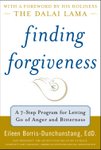


This is a sermon delivered by Martin Luther King at Dexter Avenue Baptist Church on Christmas of 1957. It deals with the question of how do we learn to love our enemies. For King the answer lies in forgiveness. In celebration of Martin Luther King day I wanted to share his inspiring words.
"First, we must develop and maintain the capacity to forgive. He who is devoid of the power to forgive is devoid of the power to love. It is impossible even to begin the act of loving one's enemies without the prior acceptance of the necessity, over and over again, of forgiving those who inflict evil and injury upon us. It is also necessary to realize that the forgiving act must always be initiated by the person who has been wronged, the victim of some great hurt, the recipient of some tortuous injustice, the absorber of some terrible act of oppression. The wrongdoer may request forgiveness. He may come to himself, and, like the prodigal son, move up some dusty road, his heart palpitating with the desire for forgiveness. But only the injured neighbor, the loving father back home, can really pour out the warm waters of forgiveness.
"Forgiveness does not mean ignoring what has been done or putting a false label on an evil act. It means, rather, that the evil act no longer remains as a barrier to the relationship. Forgiveness is a catalyst creating the atmosphere necessary for a fresh start and a new beginning. It is the lifting of a burden or the canceling of a debt. The words 'I will forgive you, but I'll never forget what you've done' never explain the real nature of forgiveness. Certainly one can never forget, if that means erasing it totally from his mind. But when we forgive, we forget in the sense that the evil deed is no longer a mental block impeding a new relationship. Likewise, we can never say, 'I will forgive you, but I won't have anything further to do with you.' Forgiveness means reconciliation, a coming together again. Without this, no man can love his enemies
"The degree to which we are able to forgive determines the degree to which we are able to love our enemies.
"Second, we must recognize that the evil deed of the enemy-neighbor, the thing that hurts, never quite expresses all that he is. An element of goodness may be found even in our worst enemy. Each of us has something of a schizophrenic personality, tragically divided against ourselves. A persistent civil war rages within all of our lives. Something within us causes us to lament with Ovid, the Latin poet, 'I see and approve the better things, but follow worse,' or to agree with Plato that human personality is like a charioteer having two headstrong horses, each wanting to go in a different direction, or to repeat with the Apostle Paul, 'The good that I would I do not: but the evil which I would not, that I do.'
"This simply means that there is some good in the worst of us and some evil in the best of us. When we discover this, we are less prone to hate our enemies. When we look beneath the surface, beneath. the impulsive evil deed, we see within our enemy-neighbor a measure of goodness and know that the viciousness and evilness of his acts are not quite representative of all that he is. We see him in a new light. We recognize that his hate grows out of fear, pride, ignorance, prejudice, and misunderstanding, but in spite of this, we know God's image is ineffably etched in being. Then we love our enemies by realizing that they are not totally bad and that they are not beyond the reach of God's redemptive love.
"Third, we must not seek to defeat or humiliate the enemy but to win his friendship and understanding. At times we are able to humiliate our worst enemy. Inevitably, his weak moments come and we are able to thrust in his side the spear of defeat. But this we must not do. Every word and deed must contribute to an understanding with the enemy and release those vast reservoirs of goodwill which have been blocked by impenetrable walls of hate.
"Let us move now from the practical how to the theoretical why: Why should we love our enemies? The first reason is fairly obvious. Returning hate for hate multiplies hate, adding deeper darkness to a night already devoid of stars. Darkness cannot drive out darkness; only light can do that. Hate cannot drive out hate; only love can do that. Hate multiplies hate, violence multiplies violence, and toughness multi# plies toughness in a descending spiral of destruction.
"So when Jesus says 'Love your enemies,' he is setting forth a profound and ultimately inescapable admonition. Have we not come to such an impasse in the modern world that we must love our enemies-or else? The chain reaction of evil-hate begetting hate, wars producing more wars-must be broken, or we shall be plunged into the dark abyss of annihilation.
"Another reason why we must love our enemies is that hate scars the soul and distorts the personality. Mindful that hate is an evil and dangerous force, we too often think of what it does to the person hated. This is understandable, for hate brings irreparable damage to its victims. We have seen its ugly consequences in the ignominious deaths brought to six million Jews by hate-obsessed madman named Hitler, in the unspeakable violence inflicted upon Negroes by bloodthirsty mobs, in the dark horrors of war, and in the terrible indignities and injustices perpetrated against millions of God's children by unconscionable oppressors.
"But there is another side which we must never overlook. Hate is just as injurious to the person who hates. Like an unchecked cancer, hate corrodes the personality and eats away its vital unity. Hate destroys a man's sense of values and his objectivity. It causes him to describe the beautiful as ugly and the ugly as beautiful, and to confuse the true with the false and the false with the true.
"A third reason why we should love our enemies is that love is the only force capable of transforming an enemy into a friend. We never get rid of an enemy by meeting hate with hate; we get rid of an enemy by getting rid of enmity. By its very nature, hate destroys and tears down; by its very nature, love creates and builds up. Love transforms with redemptive power.
"The relevance of what I have said to the crisis in race relations should be readily apparent. There will be no permanent solution to the, race problem until oppressed men develop the capacity to love their enemies. The darkness of racial injustice will be dispelled only by the light of forgiving love. For more than three centuries American Negroes have been battered by the iron rod of oppression, frustrated by day and bewildered by night by unbearable injustice and burdened with the ugly weight of discrimination. Forced to live with these shameful conditions, we are tempted to become bitter and to retaliate with a corresponding hate. But if this happens, the new order we seek will be little more than a duplicate of the old order. We must in strength and humility meet hate with love.
"My friends, we have followed the so-called practical way for too long a time now, and it has led inexorably to deeper confusion and chaos. Time is cluttered with the wreckage of communities which surrendered to hatred and violence. For the salvation of our nation and the salvation of mankind, we must follow another way.
"While abhorring segregation, we shall love the segregationist. This is the only way to create the beloved community.
"To our most bitter opponents we say: 'We shall match your capacity to inflict suffering by our capacity to endure suffering. We shall meet your physical force with soul force. Do to us what you will, and we shall continue to love you. We cannot in all good conscience obey your unjust laws because noncooperation with evil is as much a moral obligation as is cooperation with good. Throw us in jail and we shall still love you. Bomb our homes and threaten our children, and we shall still love you. Send your hooded perpetrators of violence into our community at the midnight hour and beat us and leave us half dead, and we shall still love you. But be ye assured that we will wear you down by our capacity to suffer. One day we shall win freedom but not only for ourselves. We shall so appeal to your heart and conscience that we shall win you in the process and our victory will be a double victory.'"
Showing posts with label forgivenss and healilng. Show all posts
Showing posts with label forgivenss and healilng. Show all posts
Sunday, January 17, 2010


Tuesday, June 30, 2009
Forgiveness helps you recognize that what you think you see is not there
What makes forgiveness so hard to achieve is that it requires us to recognize that what we think we see in each other is not really there. What happens to all of us is that we all have our "shadows" - things about ourselves we would rather not acknowledge. We do not want to see those parts of ourselves which we have judged to be negative. Instead we use this inner lens to view the rest of the world. To heal ourselves means owning all parts of ourselves so we can make different choices and to recognize that we are all capable of doing the same things given similar circumstances. That is what forgiveness teaches us. As "A Course in Miracles" (p401, section 1) has reminded us:
"Forgiveness recognizes what you thought your brother did to you has not occurred.
It does not pardon sins and make them real. It sees there was no sin.
And in that view are all your sins forgiven.
What is sin, except a false idea about God's Son?
Forgiveness merely sees its falsity,and therefore lets it go.
What then is free to take its place is now the Will of God."
"Forgiveness recognizes what you thought your brother did to you has not occurred.
It does not pardon sins and make them real. It sees there was no sin.
And in that view are all your sins forgiven.
What is sin, except a false idea about God's Son?
Forgiveness merely sees its falsity,and therefore lets it go.
What then is free to take its place is now the Will of God."
Saturday, June 27, 2009
Don't try to Forgive!
I was reading something very interesting about forgiveness the other day. It's message was don't work at forgiving. I smiled wondering what was going to be said next. The true meaning of forgiveness is about changing our thinking which in effect is undoing the way we think now. It is a shift from the way our ego wants to see the world, through what we think is important to us, our wants and needs or seeing the world through our anger or fear. When we truly learn how to forgive we make a decision to see the world differently. The way we achieve this is by undoing what we normally tend to do. How do we do this? You sit quietly and just observe your thoughts and behaviors. Just simple watch without judgment. Over time you will see that the choices and thoughts you have are not what you really want if you truly want to be happy. Ken Wapnick, a psychologist who teaches the profoundness of "A Course In Miracles" and runs the Foundation for A Course in Miracles once commented "Forgiveness doesn't mean that you are filled with sweetness and light. It means you forgive yourself for being filled with anger and hatred." It is by seeing what we do not want to see in ourselves that we begin to heal. When we do that we can begin to make other choices which is how we begin to forgive ourselves.
Saturday, December 20, 2008
Healing Conflict through Forgiveness
I teach about forgiveness and conflict resolution both in my private practice as a psychologist as well as in corporations and with governments when I give trainings in conflict resolution and peace building in dangerous areas of conflict as a political psychologist. On a very pragmatic level forgiveness is part of a conflict resolution process. We have to heal before we can forgive and sometimes when we begin to understand why we are angry, and what are the underlying issues that caused the conflict we can begin to stop asking the question "why me" and start asking the question "why them?" what brought them to the place that they are which influenced how they behaved. This is not only part of a conflict resolution process, but also the forgiveness process. This allows us to begin to change our perceptions of the situation and begin to look at it with compassion and understanding. This is what forgiveness is about.
Subscribe to:
Posts (Atom)